
How H. pylori infection can affect a child's health

Helicobacter pylori is a type of bacteria that commonly infects the stomach, affecting over half of the world's population. It often occurs during childhood. It can cause harm to the stomach and small intestine tissues, leading to inflammation, redness, and soreness, and can also increase the risk of stomach ulcers.The risk of getting an ulcer is higher if your child has an H. pylori infection in their stomach.In some cases, an H. pylori infection can also lead to stomach cancer.
What causes an H.pylori infection in children?
Health experts don’t know for sure how H.pylori infection is spread. They believe it's passed through the fecal-oral route, that's means you take the germs into your body through contact with excreted H.pylori from another person.Your child may contract the bacteria through exposure to contaminated food or water,such as:
1. Drink water from not cleaned water source.
2. Eat some foods didn't well-cooked.
3. Doesn’t wash their hands well after going to the bathroom.
What are the symptoms of an H. pylori infection in a child? 
Most people have an H.pylori bacteria for many years without knowing it, because they don’t have any symptoms. Although the experts don’t know why.
After being infected with H.pylori, your child may have an inflammation of the stomach lining. This is called gastritis. But most people never have symptoms or problems from the infection.Symptoms may include:
- Lack of appetite
- Loss of weight
- Having an upset stomach or nausea
- Swelling or bloating
- Vomiting
Why parents should be aware of H. pylori risks for their children
When signs or symptoms do occur with H.pylori infection, they may include belly pain, which can:
- Be a dull, gnawing pain.
- Happen 2 to 3 hours after a meal or immediately after.
- Come and go for a few days or weeks.
- When your child’s stomach is empty, it will occur in the middle of the night.
How to test your child for H. pylori:3 common tests
1.Urea breath test

This test checks your child's breath to see if your child has H. pylori bacteria in the stomach.Kids may not like the urea breath test because it involves drinking a special solution that contains urea, which has a slightly unpleasant taste.The test may also cause anxiety or discomfort for some children, leading to an unpleasant experience overall.
2.Stomach biopsy

A small sample (biopsy) is taken from the lining of your child's stomach and small intestine. The samples are checked for H. pylori.Stomach biopsy can be an uncomfortable and invasive procedure for children as it involves taking a sample of tissue from their stomach and small intestine.There is a small risk of bleeding or infection from the procedure.
3.Stool antigen test
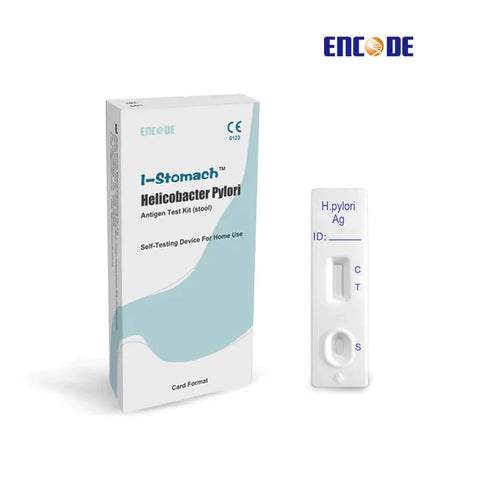
A doctor may request an Helicobacter pylori self test kit, It's a kind of home rapid test.
Stool antigen test is considered the best way to test for H. pylori in children for several reasons.First, it is a non-invasive and painless test, which makes it easier and more comfortable for children to test. First, it is a non-invasive and painless test, which makes it easier and more comfortable for children to 99%. Additionally,it is a cost-effective test and can be easily performed at home or in a clinical setting.Finally, the test has a high level of patient compliance and acceptance, as it only requires a small stool sample and does not involve any discomfort for the child.
Concerned about an H. pylori infection? Our Helicobacter pylori test kit is a simple and cost-effective way.With 99.5% accuracy and clear instructions , you can get reliable results quickly and easily - no lab visit required. This easy-to-use kit provides results in just 10-15 minutes,this kit is a reliable option for anyone concerned about Helicobacter pylori.
Reference:
What is H. pylori (Helicobacter pylori)?
Explore More Blogs:
2022-2023 Best Home Hemoglobin Meter Buyers Guide
Cholesterol test at home: What is the best home cholesterol test
9 Best At-Home Kidney Tests Buyers Guide In 2022
Best Portable Oxygen Concentrator of 2023
How to choose a best Portable ECG/EKG Monitor?
Can Helicobacter pylori be serious?
Adapting Your Diet After H. pylori Treatment: How to Check for Recovery
The article is for reference only and cannot be used as a basis for consultation. If you have any questions or symptoms, please consult a qualified physician. Some of the articles on Medasia.Store website are from the internet, some of them are not sure of the authenticity of the content, author and source of the articles, we do not take any legal responsibility for the authenticity of the content of the articles. We will not use the articles for commercial purposes, reprinted articles are for sharing use only, if it involves infringement or inaccuracy, please be sure to contact us first to delete! We respect and appreciate originality.